Real Money Casino Table Games in Australia
 Available in AU
See how live and software tables differ, what Bitcoin changes at payment, and what game odds can—and cannot—show.
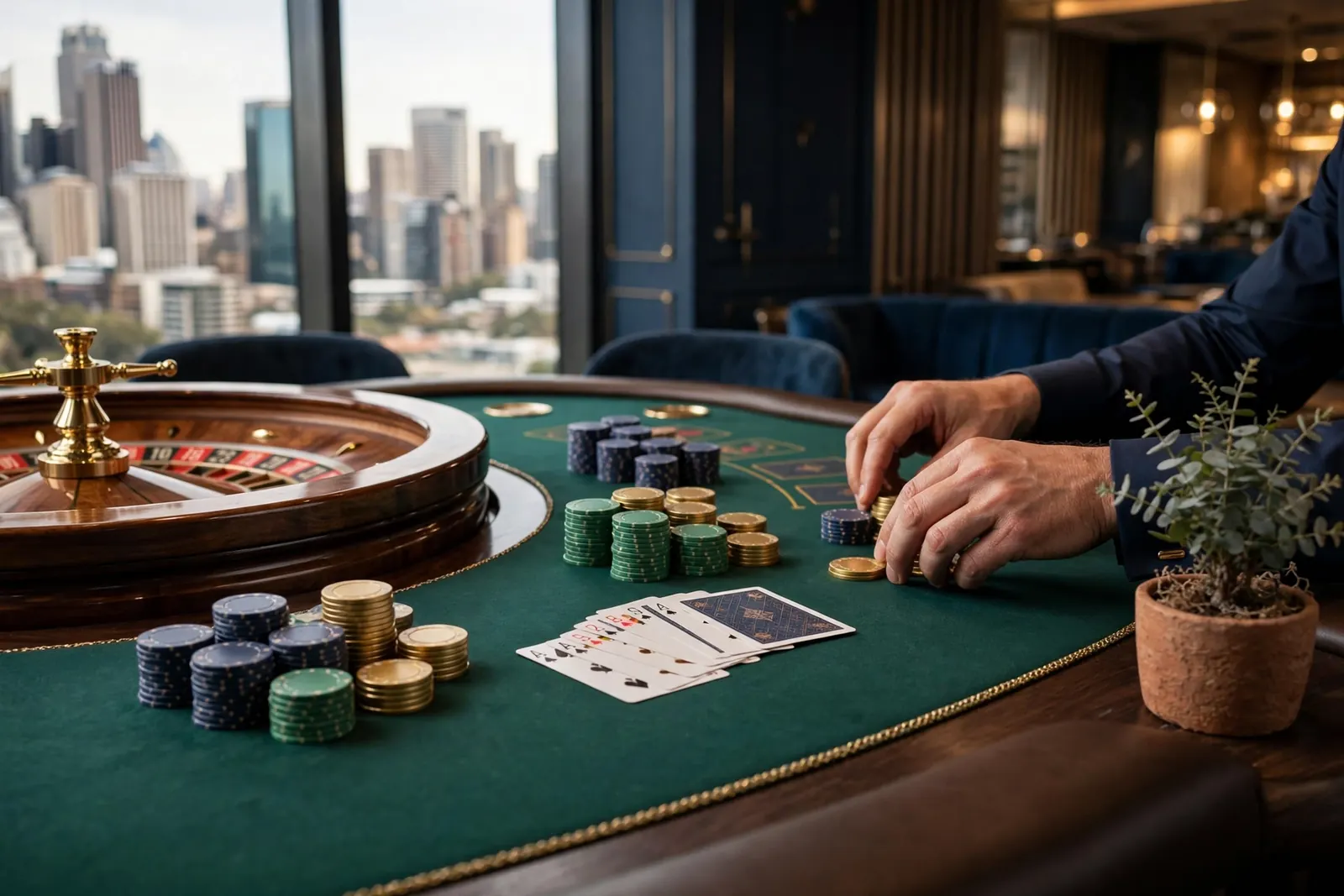
Table of Contents
- Online Tables: Live Dealers, Random Outcomes and the Australian Boundary
- Bitcoin at the Table: A Payment Rail, Not a Different Game
- What the Odds Question Can—and Cannot—Establish
- A Hand, a Dealer, a Pair of Dice: How Play Takes Shape
- The Casino Near Me Question, Without a Verified Map
- What Counts as a Casino Table Game?
- The Games Described Here, Without an Empty “Best Of”
- Cards at the Table: Competing Hands and Betting on Outcomes
- Roulette’s Green Pockets and the Question of Free Play
- Poker’s Contest of Hands
Online Tables: Live Dealers, Random Outcomes and the Australian Boundary
An online table can look like a room, a screen or a stream. Those appearances describe different ways of producing a game, not different legal permissions. A live-dealer table sends video from a real dealer working with real casino equipment to players watching remotely. In a software-based version, there is no streamed physical table determining the result: a Random Number Generator (RNG) selects the cards dealt or determines where a roulette ball lands.
The distinction matters because “live” can sound like a promise of proximity. It is not quite that. The dealer and equipment are real, but the player remains on the other side of a broadcast. The software version dispenses with that visible human scene and produces outcomes through a random process. A screen may make the two formats feel like neighbouring doors into the same establishment. Technically, they are different arrangements.
The label “online casino table games” can cover both. It says little by itself about whether a dealer is on camera, whether software generates the result, or where the operator is based. Nor does a live stream turn a remote service into a local casino. The venue may be visible as moving images; the service is still being supplied online.
Choosing a real-money casino for table games in Australia means checking the available operator information as well as the games themselves. These notes highlight the stated licensing, deposit and payout details that may help frame your research.
License: Curacao (operating since 2017) · Min. deposit: A$20 Uptown Pokies has operated since 2017 under a Curacao licence. Its stated minimum deposit is A$20.
License: Curacao, operated by Dama N.V. 7Bit Casino is operated by Dama N.V. and holds a Curacao licence.
License: Curacao OGL/2024/1335/0780 · Min. deposit: EUR 20 Vegaz Casino lists Curacao OGL/2024/1335/0780 as its licence. Its stated minimum deposit is EUR 20.
License: Curacao eGaming OGL/2024/923/0383 (Antillephone N.V.) · Min. deposit: A$30 WinSpirit Casino lists a Curacao eGaming licence, OGL/2024/923/0383, issued through Antillephone N.V. Its stated minimum deposit is A$30.
License: Curacao Gaming Control Board JustCasino lists the Curacao Gaming Control Board as its licensing authority.
License: Tobique Gaming Commission · Payout speed: crypto ~10-15 minutes, fiat 1-5 days · Min. deposit: A$30 SkyCrown lists a Tobique Gaming Commission licence. Its stated payout times are around 10–15 minutes for crypto and 1–5 days for fiat; the minimum deposit is A$30.
License: Curacao eGaming (Dama N.V.) JeetCity Casino lists a Curacao eGaming licence and names Dama N.V. in connection with it.
License: international iGaming licence – jurisdiction not named in the source · Payout speed: PayID 1-24 hours · Min. deposit: A$30 (PayID from A$10) House of Pokies lists an international iGaming licence, though the source does not name the jurisdiction. Its stated minimum deposit is A$30, or A$10 for PayID; PayID payouts are listed at 1–24 hours.
License: Curacao Gaming Control Board OGL/2023/176/0095 (Hollycorn N.V.) Neospin lists Curacao Gaming Control Board licence OGL/2023/176/0095, associated with Hollycorn N.V.
License: Curacao – Antillephone N.V. (Versus Odds B.V.) · Min. deposit: EUR 20 Thor Casino lists a Curacao licence through Antillephone N.V., with Versus Odds B.V. also named. Its stated minimum deposit is EUR 20.
In Australia, that last point is decisive. The Interactive Gambling Act 2001 governs the provision of online gambling services, and its restriction is directed at operators, not at the visual format of a table. Section 5 places real-money interactive casino games outside what Australian-based operators may offer to people in the country. The prohibition covers online casino services whether their tables are streamed from a studio or their outcomes are generated by software.
That boundary makes the familiar distinction between live and RNG-based games useful for understanding format, but not for finding a lawful local route to real-money play. A dealer on camera does not change the service into something exempt from the rule. Nor does removing the dealer. The legal question concerns the provision of the online casino game to people in Australia, not whether its outcome arrives through a broadcast or a random-number process.
The Australian Communications and Media Authority (ACMA) is responsible for enforcement. Its compliance work includes blocking unlicensed gambling platforms. In practical terms, a site appearing in search results or loading on a device cannot be treated as evidence that the service is authorised for Australian residents. Access, visibility and permission are separate matters. The internet is very good at making them look like one.
This is also why phrases such as “best online live casino table games” do not settle anything meaningful about the Australian boundary. “Live” describes the stream, not a local entitlement. Likewise, labels built around online tables or real-money play do not alter the restriction. An offshore location does not supply a local authorisation, and the ban on operators providing these services to people in Australia is not avoided by placing the dealer, equipment or software elsewhere.

The same restraint applies to claims about free tables or promotions. A promotional label cannot rewrite the underlying rules for an online casino service, and a page describing a bonus is not proof that the service may lawfully be offered in Australia. There is no need to confuse the marketing language of a website with the legal status of what it sells. The distinction is plain, even when the presentation is not.
So the two formats can be described without treating either as an invitation. Live-dealer games use real people and equipment, with the action sent to players as a video stream. Software versions use an RNG to determine game events, including the dealt cards or the roulette ball’s destination. Both are online forms of casino table play. In Australia, real-money versions fall on the prohibited side when offered to people in the country.
A camera can lend a game the atmosphere of a room; a random-number generator can make the room unnecessary. Neither changes the rule. The format changes. The boundary does not.
Bitcoin at the Table: A Payment Rail, Not a Different Game
Bitcoin does not sit at the table. It sits, conceptually, on the payment side of the arrangement: a means of transferring value, not a set of rules for play. The distinction is plain, though casino language tends to blur it. A table game concerns what happens within the game; a payment method concerns how money moves around an account. Calling something a Bitcoin table game joins two separate descriptions, not two versions of the same thing.
Bitcoin is a payment rail used for transferring value; it does not change the rules of the table game or how the game is played.
That distinction matters because a payment label can sound like a feature of the game itself. It is not evidence that a hand is dealt differently, that a roulette ball behaves differently, or that the terms of play change. “Bitcoin” describes the payment rail. “Table game” describes the activity. The combination says nothing, by itself, about the game’s rules or its probabilities.
Nor does the currency determine whether a table is physical, streamed or digitally simulated. Those are questions about how the game is delivered. Bitcoin belongs to a different part of the picture. A player could encounter the same broad kind of table-game interface under different payment arrangements; changing the payment method does not, on its own, change the game. The machinery of money and the machinery of play are separate, even when a website presents them side by side.
The practical distinction becomes clearer at withdrawal. Bitcoin transfers rely on blockchain confirmations. A specialist review reports that some withdrawals process within 10–30 minutes, with the timing dependent on those confirmations rather than on banking bureaucracy. That is a report from one review, not a dependable promise about every service or transaction. The network has its own conditions, and the wording of a payment page cannot make those conditions disappear.
This also explains why a comparison between Bitcoin table games and “normal” table games is slightly misframed. The games are not defined by whether Bitcoin is involved. A comparison would need to separate the game’s rules from the payment arrangements around it. Without that separation, a payment option may be mistaken for a game feature, and a promotional label may be mistaken for useful information. Neither mistake helps clarify what is being offered.

The same caution applies to requests for the best Bitcoin casino table games, the best table games in a casino, or a table top game that suits a particular mood. Bitcoin does not supply a ranking. Nor does its presence establish that a game is better, fairer or more suitable. A “top” label is an opinion or a promotional device unless it is tied to a stated criterion; the payment method provides no such criterion. The green felt, real or pictured, is no more informative about the payment rail than the payment rail is about the felt.
There is a further boundary in Australia: real-money online casino games are prohibited when offered to people physically located in the country. A cryptocurrency option does not alter that legal status. Calling an arrangement a BTC casino table game cannot turn a prohibited service into a different category of activity. The payment method is not a legal exemption.
That point is worth keeping separate from the technical one. Blockchain confirmations describe a feature of transferring Bitcoin; they do not certify a casino, endorse its games, or establish that a service may lawfully be offered in Australia. A payment mechanism can be technically distinct from a game and still be part of a wider service subject to law. The distinction is useful precisely because it does not settle every other question.
Legal Boundary
Real-money online casino games are prohibited in Australia under the Interactive Gambling Act 2001, regardless of whether Bitcoin is used as the payment method.
So “Bitcoin at the table” is best understood as shorthand for a payment arrangement associated with table play, not a special kind of table game. The cards, dice or wheel do not acquire Bitcoin rules. The transfer does not become a measure of game quality. And the word “open” on a page would not, by itself, establish that real-money play is available lawfully to people in Australia.
Two different systems.
What the Odds Question Can—and Cannot—Establish
“Best odds” sounds like a clean comparison: put the games in order and choose the one nearest the top. But a table-game label is not a probability. A useful comparison depends on the particular wager, the rules attached to it and the payout offered. Without those details, a ranking is decoration with arithmetic implied.
The phrase house edge is often used to compress that comparison into a single figure. It can be meaningful, but only when its assumptions are visible. A figure calculated for one set of rules, or for one way of betting, cannot automatically describe every version of a game. Nor does a general description of blackjack, roulette or dice play establish the likelihood of a particular result. The name on the table tells too little.
That is why a casino table-games house-edge chart should be read as a specification, not a league table. Each entry needs to say what is being compared: which wager, which rules and which payout conditions. If the chart leaves those out, a neat row of percentages creates confidence without showing its working. The missing detail is not footnote material. It is the comparison.

There is another distinction between probability and experience. A calculated edge describes a mathematical relationship under stated conditions; it does not predict what will happen in a short spell of play. Individual outcomes can vary, and a run of results cannot, by itself, prove that a game has become favourable or unfavourable. The language of “hot” tables makes randomness sound like a mood. It is a familiar human habit: order is comforting, especially when money is involved.
So what casino table games have the best odds? The honest answer is that no general ranking follows from the game names alone. A defensible answer would require verified, comparable probabilities for the specific choices being assessed. If those are not set out, calling one game the best—or another the worst—goes beyond what the description can establish. It may still be possible to compare particular wagers, but not by treating a broad category as though it were one fixed mathematical object.

The same caution applies to claims about “best casino odds” as a general quality. A game can contain several betting options, and a broad label can conceal differences between them. Even a precise-looking figure is only as useful as its stated basis. Precision is not the same thing as completeness.
There is also a boundary between explaining probabilities and recommending a way to gamble. A mathematical comparison does not promise a return, identify a reliable source of income or turn chance into control. In Australia, real-money online casino games are prohibited services under the Interactive Gambling Act 2001; an odds discussion does not alter that legal position. Arithmetic has limits. So does the table.
A Hand, a Dealer, a Pair of Dice: How Play Takes Shape
At a table, play is organised around an action and something to judge. In blackjack, the action is assembling a hand; in a dice game, it is rolling a pair and placing a bet on the outcome. The forms differ, but both make the central business visible: participants commit to an event, then wait for its result.
Play is organised around assembling a hand to reach a value closer to 21, measured against the dealer’s hand.
Players roll a pair of dice and place a wager on the specific outcome of the roll.
Blackjack gives the contest a human focal point. A player’s hand is measured against the dealer’s, with the aim of reaching a value closer to 21. The dealer is not simply scenery behind the table. The dealer’s hand is the opposing measure, giving each player’s result a clear counterpart. Attention moves between the two: a hand being formed on one side, the dealer’s on the other.
That comparison is the game’s basic shape. It does not, by itself, explain every decision or rule that may apply at a particular table. But it does explain why the dealer matters. The contest is not a race among players to produce the most impressive cards; each player’s task is to come closer to the target than the dealer does. The table makes that relationship legible, hand by hand.
Dice betting has a more concentrated gesture. Players roll a pair of dice and bet on the outcome. There is no competing hand to compare with the dealer’s: the roll supplies the event, and the wager gives it significance. The brief interval before the dice settle is part of the structure. A small physical action carries a larger social one, because everyone at the table can watch the same result arrive.
The distinction matters when describing how casino table games are played. Blackjack centres on a comparison between hands; dice betting centres on a roll and the outcome selected by a wager. Neither description supplies a universal set of instructions for every table, and neither should be mistaken for a ranking of which game is best. They show instead how different games assign roles: one asks a player to face the dealer, the other makes the dice the immediate focus.

This is also why learning a game cannot be reduced to memorising its name. The useful first question is what the participants are doing. Are they trying to form a hand that fares better against the dealer, or betting on what a pair of dice will produce? Once that is clear, the table’s arrangement stops looking like a collection of props and starts to read as a set of relationships: player and dealer, wager and outcome, expectation and result.
There is a quiet choreography to both. In blackjack, the hand becomes meaningful through comparison. In dice betting, the roll turns a prediction into an observable result. The dealer, the cards, the dice and the wager each have a job; remove the relationship between them and the game’s shape disappears. The furniture is only half the story.
In Australia, real-money online casino games offered to people in the country are prohibited for operators under the Interactive Gambling Act 2001. Describing the mechanics is not an invitation to play for money. The distinction is plain enough.
The Casino Near Me Question, Without a Verified Map
“Near me” is a request for geography, not a description of a game. It asks whether a physical venue is within reach, what sort of table play it offers, and whether it is open when someone arrives. Those are practical details, but they cannot be inferred from the words casino and table games alone. A result that sounds local is not, by itself, a confirmed location or an assurance that a particular game is available.
Attention: A search result appearing as “near me” is not evidence of a verified physical location or a local authorisation for online services.
The Australian legal setting adds a distinction that is easy to blur. The Interactive Gambling Act 2001 prohibits operators from providing real-money online casino games to people physically in Australia. That rule concerns an interactive service delivered remotely. It does not, on its own, identify a land-based venue, establish where one operates, or say what a nearby casino offers. A question about physical proximity therefore needs evidence of a different kind from a description of online play.
This matters because familiar searches often travel across borders without announcing the journey. Someone looking for a casino in Miami or Ohio is asking about places in the United States, not about Australian neighbourhoods. Search results can mix regions, business listings and general casino pages; a result that uses the right words may still be irrelevant to the place being considered. Geography is not a decorative detail.
Nor does a venue’s name settle the question of its table floor. The phrase “casino with table games” may refer to a broad category, while a particular visit depends on what is actually operating at a particular site. Opening details and game availability are time-sensitive, and a general description cannot substitute for current venue information. Without a confirmed location and operating details, “closest” remains a measurement without a starting point or destination.
There is a small social history in the phrase “near me.” It treats a casino much like a shop or station: a point on a map, measured by distance and convenience. Yet gambling venues are also institutions, governed by rules that differ according to whether play is physical or delivered online. In Australia, the federal prohibition on providing real-money online casino services is a clear boundary for the latter. It should not be stretched into a claim about a nearby building, or mistaken for a directory of physical venues.
That leaves the local question deliberately narrow. A description of blackjack, roulette, poker or dice play cannot establish that any one of them is available at a nearby site. And a general legal summary cannot supply an address, opening hours or confirmation that a particular venue exists in the area. The sensible distinction is between what a game is and where it can be found.
A map would answer the first practical question only if its locations and details were verified. Without that, naming a “nearest” casino would create the appearance of certainty while supplying none. The geography stays blank.
What Counts as a Casino Table Game?
A casino table game is best understood as a kind of play, not a particular screen, room or piece of equipment. The label describes the game category; it does not, by itself, say how the game is delivered or whether it is available for real-money play in a given place.
That distinction matters because the same table-game format can appear in different online forms. In a live-dealer game, a real dealer works with real casino equipment, while a camera streams the action to players. The screen is a window onto a physical setup. The dealer and equipment are not animations generated by the game software.
- Distinguish between live-dealer streams and RNG software
- Understand that the interface is separate from the outcome generator
- Assume a visual table implies a physical dealer
- Confuse a visual resemblance with a mechanical description
An online version can instead produce outcomes through a Random Number Generator, or RNG. In that format, software determines such things as which cards are dealt or where a Roulette ball lands. The familiar image of a table may still appear on screen, but it does not mean a physical dealer or wheel is determining the result. A visual resemblance is not a mechanical description.
The distinction is useful when asking what counts as a casino table game: the game’s category and its delivery method are separate questions. A live stream describes how an event is shown; an RNG describes how an outcome is selected. Neither term is another name for the underlying category. The interface can make the two formats look similar, but their sources of action differ.
That also explains why the phrase “table game” does not necessarily mean a literal table is present where the player is. In streamed play, real equipment is part of the dealer’s setting. In an RNG version, the table may be only an onscreen representation. In both cases, the category comes from the kind of game being presented, not from the furniture in view. A table can be real, or it can be scenery.
Software can be part of the explanation without becoming the definition. An RNG is relevant because it determines outcomes in online versions; the mere presence of casino-themed software does not establish that a game uses a physical dealer or equipment. Nor does the word “table” tell anything about a casino’s management systems. Those are separate subjects, and the category alone cannot settle them.
For Australia, the term should also be kept separate from the question of lawful real-money availability. Online casino-style table games offered to people in Australia are prohibited interactive gambling services under the Interactive Gambling Act 2001. A description of a format is not an invitation to use it.
So, in plain terms, casino table games are a category that can be represented through live-dealer streaming or through software-generated outcomes. The format changes the machinery behind the screen, not the meaning of the label. Two different stages.
The Games Described Here, Without an Empty “Best Of”
A short catalogue of table games can look like a promise to rank them. That would flatten distinct forms of play into a contest they do not share. Blackjack, baccarat, dice betting and poker offer different centres of attention: a hand measured against a dealer, a wager on which hand prevails, a pair of dice and its result, or the effort to assemble the strongest poker hand.
In blackjack, the player’s hand is set against the dealer’s, with the aim of finishing closer to 21. The dealer is not simply a host; the dealer is the other side of the contest. That arrangement gives the game a clear focus: one hand measured against another. It also explains why a list of card games is not the same thing as a list of games with the same social shape. Blackjack makes the opposition explicit.
Baccarat shifts the emphasis from building a hand to choosing what to back. Bets may be placed on the player’s hand, the Banker’s hand or a tie. The names can suggest a personal duel, but the central act is wagering on an outcome. It is a compact structure, with attention fixed on which of the named possibilities comes to pass. A game can be easy to describe without being interchangeable with the next one.
Focuses on wagering on which hand prevails: the player’s, the Banker’s, or a tie.
Centred on the roll of two small cubes and the resulting outcome.
A contest among players to assemble the strongest possible poker hand.
Dice betting puts the pair itself at the centre. Players roll two dice and wager on the outcome. Here, the objects of play are visible and familiar: two small cubes, their fall, and the result that follows. The appeal of the format does not require a cast of competing hands. Its drama is concentrated in a throw.
Poker turns back to hands, but with a different aim from blackjack. Players compete to build the best possible poker hand. The contest is among players, and the hand is something each participant tries to make as strong as possible. That gives poker a different social arrangement from a game framed around the dealer or around a wager on named outcomes. The hand is both the object being formed and the measure of the contest.
These descriptions are enough to distinguish several kinds of table play without pretending they exhaust the category. Some are organised around a dealer, some around a wager, some around dice, and some around competing hands. Calling one the best would require a shared measure that these games do not supply. A catalogue, not a verdict.
Cards at the Table: Competing Hands and Betting on Outcomes
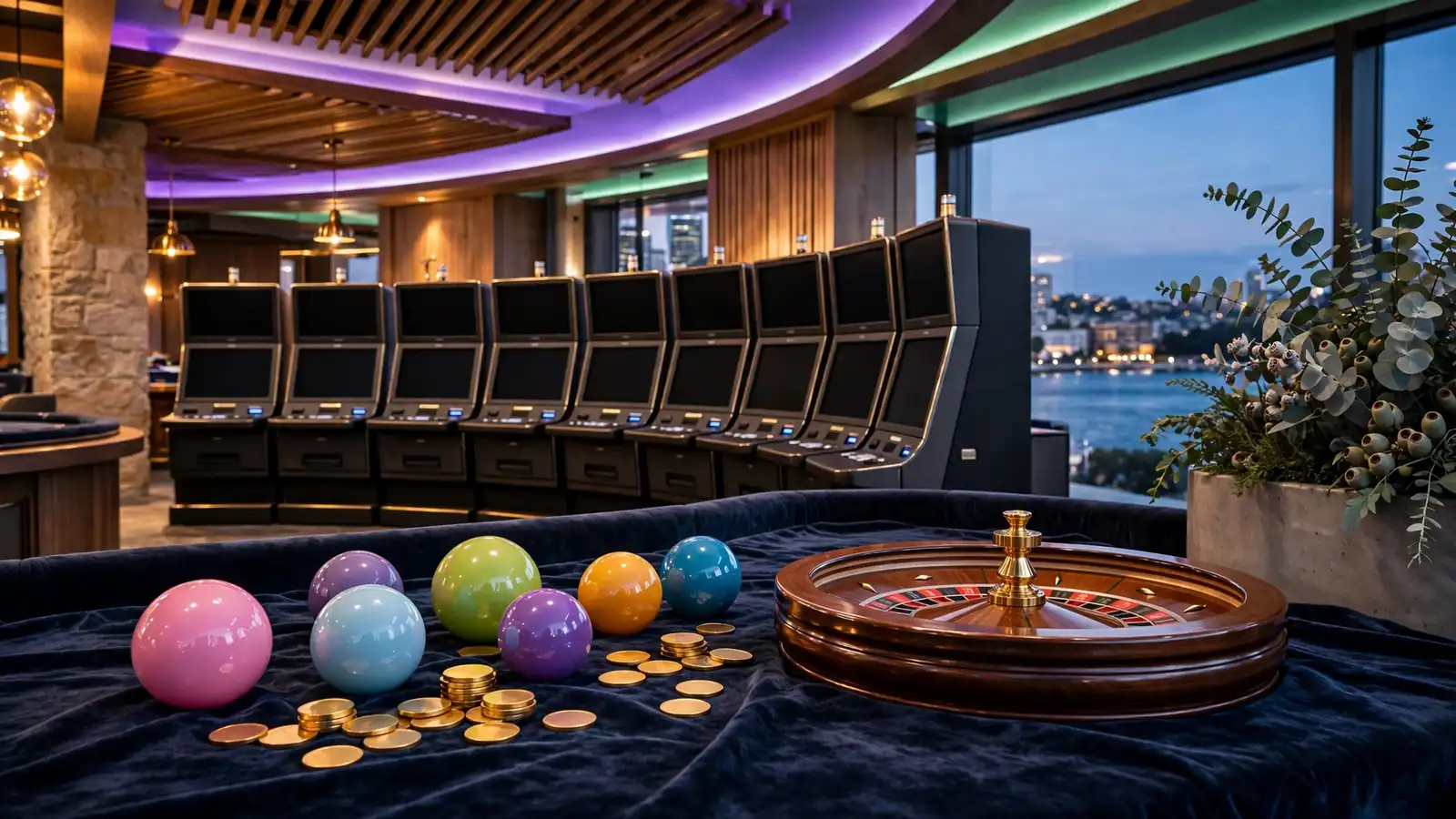
Card table games turn attention towards hands: what they contain, whose hand is being measured, and where a wager is placed. The cards matter, but so does the contest the table has arranged around them. In blackjack, the player competes against the dealer, aiming for a hand value closer to 21. The structure is spare: two sides, a shared target, and a comparison that gives each hand its meaning.
That contest is not the same as betting on which of several named outcomes will occur. In baccarat, a wager can be placed on the player’s hand, the Banker’s hand, or a tie. The choices make the object of the bet explicit. It is possible to take part by backing an outcome rather than by treating the game as a direct contest between one’s own hand and the dealer’s.
This difference helps explain why “card game” is too broad a label to tell much about the experience. Blackjack centres the player’s hand against the dealer’s; baccarat offers wagers on either hand or on a tie. Both use cards, but they organise attention differently. One asks which hand will come closer to a target; the other lets the wager point to a named result. The distinction is about the shape of the decision, not a promise that one arrangement is simpler or more favourable.
A casino card table can therefore hold more than one kind of participation. In blackjack, the hand is personal in the limited sense that it is the player’s hand being compared with the dealer’s. In baccarat, the wager may instead be attached to the Banker’s hand, the player’s hand, or the possibility of a tie. The language of the table separates the act of holding a hand from the act of backing an outcome. Small distinction. A consequential one.
These descriptions do not supply a full set of rules for either game, and they do not establish probabilities or identify a superior choice. Those claims would require detail beyond the basic contest and betting options. A card table’s appeal can be described without dressing it up as a system for predicting results.
In card games, there is a distinction between competing directly against a dealer (as in blackjack) and backing a named outcome (as in baccarat).
In Australia, the legal setting also matters: the Interactive Gambling Act 2001 prohibits operators from providing real-money online casino games, including table games, to people in the country. A description of blackjack or baccarat is not an invitation to seek out an online service. The cards may travel easily across borders; the law does not thereby travel with them.
Roulette’s Green Pockets and the Question of Free Play
Roulette’s wheel turns a game of chance into a small piece of theatre: numbered pockets, a moving ball, and a table arranged around outcomes. Its versions are easy to confuse because their names suggest geography, while the most visible distinction is built into the wheel itself.
European and French Roulette each have 36 numbered pockets and a green zero. American Roulette has those numbered pockets, a green zero and a green double zero. That additional pocket is not a decorative flourish. It is part of the game’s layout, a quiet reminder that versions sharing a name need not share an identical structure.

The green pockets interrupt the run of numbered outcomes. Against the ordered field of numbers, zero—and, on the American wheel, double zero—stands apart. It is a simple visual difference, but one that changes what is present on the wheel before any bet is placed. The table’s felt may look familiar from one version to another; the wheel tells a more precise story.
This is why roulette is better approached by its named form than as one undifferentiated casino table game. European and French Roulette belong together in the description of their numbered layout and single green zero. American Roulette has the additional green pocket marked 00. The distinction is concrete, unlike the broad promise that one version is universally preferable. A wheel has features; preference depends on what someone values in play.
Free access is a separate matter from the design of the wheel. A game being described as free does not establish what a particular venue or service offers, or on what terms. Nor does the word itself explain whether the experience uses the same format as paid play. A responsible account of roulette can describe the visible difference between its versions without turning that unknown into an invitation or a promotion.
There is a modest elegance in the wheel’s arithmetic of appearance: a field of numbered pockets, marked by green exceptions. Yet the difference between one green zero and a zero accompanied by 00 deserves more than a glance. Names travel easily; details do not.
Poker’s Contest of Hands
Poker can be understood through a compact idea: players compete to build the best possible hand. That contest gives the game its shape. Each participant is concerned not only with the cards in front of them, but with how their hand stands against the others at the table.
The hand becomes a small measure of uncertainty. Its value matters because it is compared, not considered in isolation. A player may hold something strong in one contest and find it weaker beside another hand. The central tension lies in that comparison: several people pursue the same outcome, but only one hand can prevail as best.

That is why poker table games are defined less by a solitary test than by a contest between participants. The table gives the contest a public setting; the hands supply its changing evidence. Poker’s appeal can be read in that arrangement. It turns a private hope of having the strongest combination into a shared result, visible to everyone involved.
There is no need to make the game sound more elaborate than its central premise. Poker is about trying to assemble the best possible hand, while other players are trying to do the same. The simplicity of that aim leaves room for rivalry, anticipation and disappointment without requiring a grand theory of what any particular hand means.
The Australian legal setting matters when the contest is offered for money online. The Interactive Gambling Act 2001 prohibits operators from providing real-money online poker to people in Australia. The distinction is not a quirk of the cards; it is a boundary placed around the service.
A modest premise. A firm boundary.
Can you play table games online for real money?
Online table games are offered in live-dealer and RNG formats, but real-money casino games cannot be lawfully offered to people in Australia by locally based operators. An offshore location does not make the service authorised in Australia.
What is the legal status of online table games for Australian players in 2026?
Under the Interactive Gambling Act 2001, operators based in Australia are prohibited from offering real-money interactive casino games to residents. ACMA enforces the rules, and an offshore operator is not made locally authorised by being based overseas.
Are online casinos legal in Australia?
Australian-based operators are prohibited from offering real-money online casino games to people in Australia under the Interactive Gambling Act 2001. ACMA enforces compliance and blocks unlicensed platforms.
Written by the editors at Wildtokyoslotshubau.com.