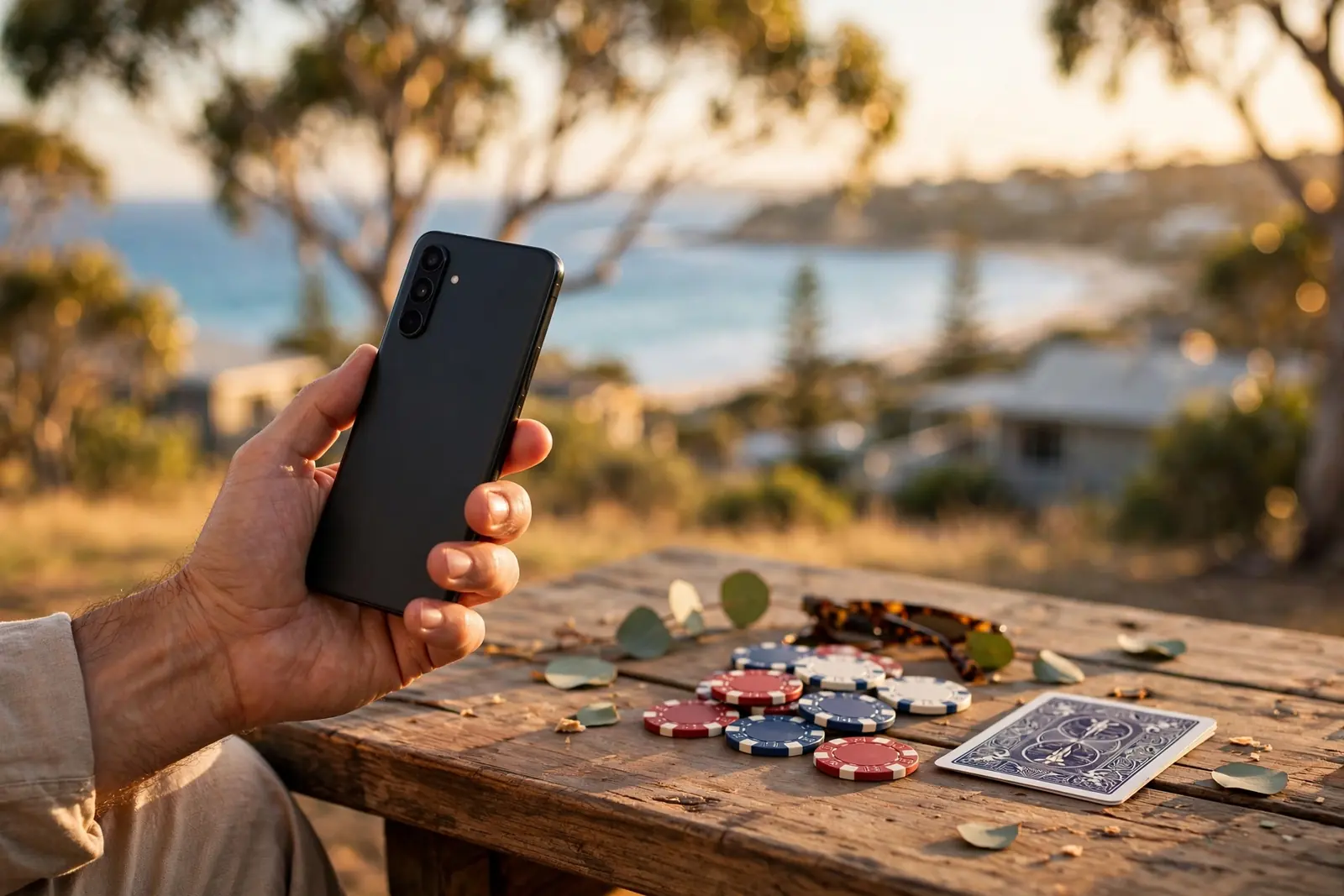
Android casino apps in Australia: how access works
 Available in AU
Australian Android casino play often uses a mobile website and an existing account rather than a dedicated app downloaded from a store.

Table of Contents
- How Android Casino Play Reaches Australian Phones
- A Casino Website That Sits Like an App
- Free Pokies, Without a Cashier
- Bonus Arithmetic and the Short Fuse
- Real-Money Play Offshore: The Legal Divide
- Slot Games and the Limits of the Mobile Screen
- The Australian Rules Behind Offshore Casino Access
- Why the App Store Is Often Missing
- Deposits, Withdrawals and the Wait Between Them
- When Casino Play Stalls on Android
How Android Casino Play Reaches Australian Phones
On an Android phone, online casino play is more often a matter of opening a website than finding a dedicated application. The browser is the usual point of entry: a punter reaches the casino’s mobile site and signs in there, rather than downloading a conventional app from a store. The distinction sounds small until the phone becomes the main screen. It changes what “casino app” means in ordinary conversation.
The account itself need not be new or mobile-specific. A casino account used on a desktop computer can often be used through the phone’s browser as well. The small screen is then another doorway to the same account, not a separate service with a separate identity. That continuity is practical, but it also means that using a phone does not make the underlying arrangement different from using a computer.
This is the basic shape of an Android casino experience in Australia: a website adapted for a phone, opened in a browser. The browser supplies the route; the account supplies continuity. There may be no app icon at all. For someone accustomed to banking, messaging or shopping through installed apps, that can feel like a missing piece. In this setting, however, the absence of a conventional download is not unusual. Browser access is the ordinary pattern.
Choosing a casino app for Android in Australia involves checking the available licensing and practical details such as deposit options or payout times. This list offers a concise reference to the details provided for each operator.
License: Curacao (operating since 2017) · Min. deposit: A$20 Uptown Pokies has operated since 2017 under a Curacao licence. Its minimum deposit is A$20.
License: Curacao, operated by Dama N.V. 7Bit Casino is licensed in Curacao and operated by Dama N.V.
License: Curacao OGL/2024/1335/0780 · Min. deposit: EUR 20 Vegaz Casino holds Curacao licence OGL/2024/1335/0780. Its minimum deposit is EUR 20.
License: Curacao eGaming OGL/2024/923/0383 (Antillephone N.V.) · Min. deposit: A$30 WinSpirit Casino holds Curacao eGaming licence OGL/2024/923/0383, issued through Antillephone N.V. Its minimum deposit is A$30.
License: Curacao Gaming Control Board JustCasino is licensed by the Curacao Gaming Control Board.
License: Tobique Gaming Commission · Payout speed: crypto ~10-15 minutes, fiat 1-5 days · Min. deposit: A$30 SkyCrown is licensed by the Tobique Gaming Commission. Its stated payout times are around 10–15 minutes for crypto and 1–5 days for fiat; the minimum deposit is A$30.
License: Curacao eGaming (Dama N.V.) JeetCity Casino is licensed in Curacao eGaming and operated by Dama N.V.
License: international iGaming licence – jurisdiction not named in the source · Payout speed: PayID 1-24 hours · Min. deposit: A$30 (PayID from A$10) House of Pokies has an international iGaming licence, though the source does not name the jurisdiction. PayID payouts are stated as taking 1–24 hours; the minimum deposit is A$30, or A$10 for PayID.
License: Curacao Gaming Control Board OGL/2023/176/0095 (Hollycorn N.V.) Neospin holds Curacao Gaming Control Board licence OGL/2023/176/0095, under Hollycorn N.V.
License: Curacao – Antillephone N.V. (Versus Odds B.V.) · Min. deposit: EUR 20 Thor Casino is licensed in Curacao through Antillephone N.V., with Versus Odds B.V. named as operator. Its minimum deposit is EUR 20.
The wording around the subject can blur these distinctions. “Casino app” may suggest a program built specifically for Android, installed from an app store and updated like other phone software. In practice, the phrase can refer more loosely to reaching a casino website on a mobile device. The experience is still mobile, even if its starting point is a browser tab. A label is not a delivery method.
That matters because the first practical choice is not necessarily between one app and another. It is whether the site can be reached and used through the phone’s browser, with the existing account details. The same account being available on desktop and mobile reduces the need to treat the phone as a separate account environment. It does not, by itself, say anything about the site’s status, reliability or suitability. Access and trust are different questions.
There is a modest cultural change in that shift. The app icon has become a kind of shorthand for legitimacy and convenience: a square on the home screen seems settled, almost domestic. A browser page feels temporary by comparison, even when it is the standard way a service is reached. Yet the familiar icon is not proof of anything beyond installation, just as a browser address is not a verdict on the site behind it. The interface can make an arrangement feel ordinary without changing what the arrangement is.
For Android users, this means that searching the phone for a dedicated casino application may not reflect how mobile access is generally organised. Many Australian mobile casinos are reached directly through a browser, and the account used on a desktop computer can also be used there. The practical routine is therefore closer to visiting a website than installing a new piece of software. That is the whole mechanism, without much ceremony.

It also helps explain why the word “app” can appear in descriptions of mobile casino play even when no store download is involved. People use it to describe the activity on the phone, not always the technical form of the product. A browser can provide the mobile route without becoming a native Android application. For now, the useful distinction is simply between opening a site and installing software; the two are often treated as if they were the same.
In Australia, that browser-first pattern sits within a more complicated setting than the language of convenience suggests. The Interactive Gambling Act 2001 prohibits operators from offering online casino-style games to people in the country. Individual players are not made criminally liable under that Act merely for playing at an offshore casino, but the operator’s position is different. An offshore site may also be inaccessible, and a phone does not alter the legal or practical circumstances. The screen is portable; the rules are not.
Any offshore casino discussed in this context is offshore and crypto-friendly, not an Australian-licensed service. Its acceptance of Australian users must be confirmed before a deposit is made. A VPN used to get around a block may put winnings at risk or lead to an account being closed, and there is no Australian government body to complain to if an offshore casino refuses to pay. These are not details supplied by the browser. They belong to the arrangement the browser opens.
Legal Risks
Using a VPN to bypass blocks may lead to account closure or voided winnings, and there is no Australian government body to assist if an offshore casino refuses to pay.
So the Android question begins with a plain answer: mobile access usually arrives through a browser, often with the same account used on desktop, rather than through a conventional app-store download. The phone makes the route smaller and more immediate. It does not make the route an app, nor does it make the service local. The browser is only the doorway.
A Casino Website That Sits Like an App
On an Android phone, an app-like casino shortcut may begin as an ordinary website. The distinction is less dramatic than the icon suggests: a Progressive Web App, or PWA, is a shortcut to a casino website, arranged to behave more like a native app on a mobile device. It can sit on the home screen and open in a compact, app-like view, while the underlying service remains web-based.
That format helps explain why “casino app” can mean something different from a program downloaded through an app store. Casinos that accept Australian players typically offer browser access or PWAs rather than native mobile apps. A PWA does not turn a website into a separately licensed Android product; it gives the website a direct place on the phone and a more app-like way to open it.
Installation, where offered, starts on the casino website itself. The site may show an install or add-to-home-screen prompt. Tapping it and confirming the installation places the shortcut on the device. The wording and appearance of the prompt can vary, but the essential action is simple: the phone saves a route back to the website. There is no need to search for a matching title in a store.

The shortcut can make return visits feel familiar. An icon provides a visible point of entry, and the site may open without the usual browser address bar taking up the same space. But the icon is not evidence that the service has become a conventional Android application. Its contents still come from the website, and its operation remains tied to that site. A polished entrance is not a different building.
This can matter when comparing descriptions of a “casino app for Android”. One listing may refer to a PWA; another may mean a website opened in a browser; a third may offer a file to download outside the usual store route. Those are not interchangeable forms. The first two are web access in different arrangements. An independently installed file is a different proposition, and its security depends on the operator that supplies it. Sideloading should not be treated as safe merely because a download page looks professional.
For Australian readers, the distinction also sits inside an unusual legal landscape. The Interactive Gambling Act 2001 prohibits operators from providing online casino-style games to people in Australia. Individual players are not made liable under that Act simply for playing at an offshore service, but that does not create a local consumer-protection route. Any casino service of this kind discussed in this context is offshore and crypto-friendly; location acceptance must be confirmed before any deposit. A VPN used to reach a blocked casino may result in winnings being voided or an account closed. If an offshore casino refuses to pay, there is no Australian government body to complain to.
PWA Nature
A Progressive Web App (PWA) is a website shortcut that behaves like a native app but remains web-based and does not change the legal or licensing status of the service.
Those cautions are not features of a PWA. They concern the operator behind the shortcut, and the legal and practical position of the service. The format itself says little about reliability, fairness or recourse. A home-screen icon can make access feel settled; it cannot settle those questions.
For someone comparing Android formats, the useful distinction is therefore not “app versus no app” but website shortcut versus separately installed software. A PWA keeps the point of entry close at hand while leaving the casino’s service web-based. A browser tab does much the same work without the icon. Neither arrangement changes who runs the site or the risks attached to using it.
There is a small cultural sleight of hand in the word app: it suggests a product contained neatly inside a phone. A PWA borrows that appearance while remaining a doorway to a website. Useful, sometimes. Native, not quite.
Free Pokies, Without a Cashier
A casino-style app can borrow the colours, sounds and routines of gambling without asking for a cash deposit. In social and free-play versions, the play balance consists of virtual credits. Those credits are not money placed at risk; the point is the play experience, not a cash win. The distinction is simple in principle, though a familiar casino design can make two very different activities look much alike.
In Australia, social and free-play casino apps that use virtual credits are legal to use and are available through both the Google Play Store and Apple App Store. That makes them different from real-money casino services, whose legal position does not change merely because the screen is small or the software is called an app. The decisive detail in this free-play model is what the credits represent: play tokens, not a deposit or a claim to money.

The interface may still reproduce the conventions of a casino. A balance appears, a button starts a round, and credits rise or fall on the screen. These visual cues are part of the format, not proof that cash is involved. For a punter weighing up a free pokies app, the useful distinction is therefore not whether it looks convincing, but whether its credits remain virtual and its play is not presented as a route to cash winnings.
That is also why “free” needs to be read as a description of the play model, not as a promise about every feature or every app using casino imagery. The relevant category is social or free-play software built around virtual credits. A similar-looking product can have a different purpose, so the label alone does not settle what kind of service it is. The virtual-credit boundary does.
Free play can appeal for reasons that have little to do with money: the familiar visual language, a brief diversion, or the chance to learn how a game’s controls work. Yet it is not a cash casino with the cashier removed. Its credits do not turn a free-play session into real-money gambling, and the presence of casino-style graphics does not make the two models interchangeable. One is an entertainment format using virtual balances; the other involves money and carries a different legal and practical context.
- Use apps with virtual credits for entertainment
- Treat free play as a way to learn game controls
- Confirm credits remain virtual
- Mistake social casino apps for cash-paying services
- Treat virtual credits as real money won or lost
- Assume a casino design implies real-money gambling
That difference matters especially when a search for an Android pokies app brings up products described in loose, overlapping terms. “Casino app” can mean a free social game or a real-money service. On Android, the platform alone says nothing about which one is being offered. The app’s own description and the role of its credits are more revealing than its icon, animation or use of casino vocabulary.
A free-play app can be a genuine option for someone who wants casino-style entertainment without staking cash. It should not be mistaken for a substitute that pays out, nor should virtual credits be treated as a measure of money won or lost. That is the clean line: play, but no cashier.
Bonus Arithmetic and the Short Fuse
A bonus is not its headline figure. Its practical value depends on what must be deposited, how much wagering is required, which games count towards that requirement and how long the offer remains active. A large credit can be difficult to convert into withdrawable funds; a smaller one with clearer conditions may impose less work. The arithmetic sits in the terms, not the banner.
Specialist reviews describe welcome-bonus wagering requirements in the range of 30x to 50x the bonus amount. Above 40x is considered steep. The multiplier matters because it sets the scale of the play required before the bonus, or winnings linked to it, can be withdrawn. The terms must also clarify whether the requirement applies to the bonus alone or to a combined deposit and bonus figure. Those are different calculations, even when the promotional wording makes them look alike.

The deposit is part of the equation. An offer may require a minimum deposit before it becomes available, and that threshold can change the cost of taking part. A no-deposit offer avoids that particular entry condition, but the label says nothing by itself about wagering, game eligibility, expiry or limits on cashing out. “Free” is a promotional description, not a summary of the contract.
Time adds another constraint. Specialist reviews report that many bonuses have to be cleared within 7–10 days; if the deadline passes first, the bonus is lost. A requirement that looks manageable in isolation may be less so when compressed into a short window. The clock may start when the bonus is credited, rather than when play begins, so the start point matters as much as the end date. A short fuse changes the calculation.
Game restrictions can narrow the available route to clearing the requirement. The terms may exclude particular games or count different games unequally towards wagering. A punter who assumes every eligible game contributes in the same way could find that progress is slower than expected. The advertised multiplier cannot be assessed without the contribution rules beside it.
Cashout caps matter at the other end. Even after the wagering condition is met, a cap may limit how much bonus-linked value can be withdrawn. The rules should be read together: wagering requirement, minimum deposit, game restrictions, expiry date and cashout cap. Looking at only one condition is how a seemingly generous offer becomes a small, tightly managed arrangement.
These offers belong to offshore crypto-friendly casinos, not Australian-licensed online casino operators. Location acceptance needs to be confirmed before any deposit; using a VPN to reach a blocked casino may void winnings or lead to account closure. If an offshore casino refuses to pay, there is no Australian government body to complain to. That is a substantial gap between an attractive number on a screen and a remedy in practice.
Bonus Claim Checklist
- Check the wagering multiplier (e.g., 30x–50x)
- Verify the minimum deposit requirement
- Note the expiry date (typically 7–10 days)
- Review game contribution and restriction rules
- Check for maximum cashout caps
Before claiming, the full terms deserve attention, including wagering requirements, game restrictions, expiry dates and cashout caps. The deposit threshold and the deadline belong in the same calculation as the bonus amount. A promotion is worth considering only when its conditions can be understood as a whole. The small print is the offer.
Real-Money Play Offshore: The Legal Divide
An Android phone changes the point of access, not the legal character of a casino game. The Interactive Gambling Act 2001 prohibits operators from offering online casino-style games to people in Australia. That prohibition concerns the service provider: putting a casino on a mobile screen does not make the offer lawful simply because it arrives through a browser or an app-like shortcut.
The position of the individual punter is different. Under the Act, an Australian player does not commit an offence merely by playing at an offshore mobile casino. That distinction can sound like permission, but it is not a government endorsement, a guarantee of fair treatment or a local route for resolving a dispute. The law places its prohibition on operators offering the service in Australia; it does not turn the player’s access into a protected consumer relationship.
Any casinos discussed in this context are offshore and crypto-friendly. That describes their location and the kind of payment they may accept, not their standing in Australia. They are not Australian casinos authorised to offer real-money casino games locally. Nor does an Android label confer a special legal status. Real-money play through an Android device remains real-money play, whatever the screen or software calls itself.

Access can also be interrupted. Australian authorities actively block illegal gambling sites, so a page that opens today may not remain reachable in the same way. A site’s own claim that it accepts Australians should not be mistaken for confirmation that an account can be opened and used from a particular location. Location acceptance needs to be confirmed with the operator before any deposit is made. If the site does not accept the location, proceeding anyway risks a dispute about account access or funds.
A virtual private network is not a dependable way around that barrier. If a VPN is used to reach a blocked casino, the operator may treat the apparent location as a breach of its rules. Winnings may then be voided, and the account may be closed. The fact that an app or website loads does not settle whether the operator will honour a later withdrawal.
That is where the distance between legal status and practical protection becomes plain. If an offshore casino withholds winnings, there is no Australian government body to complain to for help recovering them. An offshore operator is not made answerable to an Australian casino regulator simply because an Australian punter can reach its site. A dispute may instead be governed by the operator’s own terms and the rules of the place where it is based, with no local public authority available to enforce a payout.
The law’s distinction is narrow, not comforting: the operator is prohibited from providing the service in Australia, while an individual player is not made criminally liable merely for using an offshore site. Neither point guarantees safety, uninterrupted access or payment. The phone makes the distance feel small. The remedies remain far away.
Attention: The Interactive Gambling Act 2001 prohibits operators from providing casino games in Australia, meaning players have no local consumer protection when using offshore services.
Slot Games and the Limits of the Mobile Screen
Pokies are built around a simple bargain between attention and repetition: a small screen presents a game, and a tap starts another turn. On an Android phone, that simplicity can make play feel frictionless. It can also make the boundaries of a session less visible. A screen that fits in a pocket is always close at hand; the surroundings that might otherwise mark a pause can disappear behind it.
The mobile format changes how the game is handled, not what it is. Buttons designed for touch replace a mouse click, while the display has less room for controls, rules and account information than a desktop screen. Details may sit behind menus or require scrolling. That is a practical reason to slow down before starting: the key information is not always in view while the game occupies the display.
A title’s appearance or ease of use does not establish that it is more suitable, safer or more rewarding. Nor does a polished mobile layout settle the questions that matter beyond the screen: what the rules say, how play is controlled, and whether the activity is becoming difficult to stop. A smaller device does not make those questions smaller.
The word “app” can suggest a contained product with a clear edge. In practice, mobile play may sit within a broader casino account and its surrounding features. The distinction matters because the game itself is only one part of the experience. Notifications, account access and the ease of returning can all make a brief visit stretch into a longer one. The screen is portable; restraint has to be deliberate.

A specialist review describes a set of controls that may help define that restraint: deposit and loss limits, caps on wagering, session-time limits, and self-exclusion. These tools address different points in the cycle. A deposit limit restricts money going in; a loss limit sets a boundary around losses; a wager limit concerns the amount staked. A time limit marks duration rather than money, while self-exclusion is a stronger step that blocks access for a chosen period or longer, according to the operator’s arrangements. Their presence and operation should be checked rather than assumed.
Controls are not a cure for compulsive gambling, and setting one does not change the nature of the activity. They are most useful when treated as boundaries established before play, not as adjustments made in the heat of it. If those boundaries are repeatedly moved or ignored, stepping away is more meaningful than searching for a more comfortable screen.
A phone makes access intimate. It does not make the consequences abstract.
The Australian Rules Behind Offshore Casino Access
Australia’s regulatory map has a hard edge: the Interactive Gambling Act 2001 prohibits operators from offering online casino-style games to people in the country. An offshore licence does not turn that service into a locally authorised one. Names such as Curaçao, the Malta Gaming Authority and Gibraltar describe jurisdictions associated with casinos that accept Australian players; they do not confer permission to offer casino gambling in Australia.
That distinction matters because a licence is not a passport through every country’s laws. It may indicate which authority an operator says oversees it, but the Australian position remains separate. The law places the prohibition on the operator, while an individual is not made criminally liable simply for playing at an offshore casino. A boundary can be clear on paper and still complicated in practice.
A jurisdiction associated with casinos that accept Australian players.
A regulatory body for offshore operators serving the Australian market.
A jurisdiction where many offshore, crypto-friendly casinos are based.
The Australian Communications and Media Authority, or ACMA, actively blocks access to illegal gambling sites. A blocked page is therefore not just a technical inconvenience. It reflects enforcement in a market where offshore services may remain visible, but are not thereby approved or protected locally. The screen can suggest ordinary availability; the regulatory setting says otherwise.
Any casinos discussed in this context are offshore and crypto-friendly. Their acceptance of Australian residents must be confirmed directly before depositing, since access and eligibility can differ. A VPN used to reach a blocked casino may breach its terms, with winnings potentially voided and the account closed. And if an offshore operator refuses to pay, there is no Australian government body to which a punter can complain for help recovering the money. Distance has consequences.
Age is another firm threshold: registration and gambling in Australia are for people aged eighteen or over. That requirement does not depend on whether a service is reached through a browser, an app-like shortcut or another mobile route. The device changes; the threshold does not.
The result is an uneasy arrangement: foreign jurisdictions may license operators, while Australian authorities block services considered unlawful here. Neither a familiar licence name nor a working page erases that divide. A phone can cross borders in seconds. Legal protection does not travel with it.

Why the App Store Is Often Missing
A search for casino apps on an Android phone can end in a conspicuous absence. Conventional casino apps are rarely listed on Google Play in Australia, and the Apple App Store is similarly sparse. For offshore operators that accept Australians, the ordinary route is therefore a mobile browser or a Progressive Web App, rather than a download from an official store.
That absence is not simply a matter of taste in software. App stores are curated distribution systems, while online casino-style gambling is prohibited for operators serving people in Australia under the Interactive Gambling Act 2001. The result is a mismatch: interest in phone access exists, but the familiar storefront is not where most real-money casino services appear. Browser access takes the place of an app icon. Less conspicuous, not less consequential.
A website shortcut can offer an app-like presence without being a conventional native app. That distinction matters when an operator instead offers an Android installation file outside Google Play. Sideloading removes the store’s usual distribution checks; it does not, by itself, prove that a file is malicious, but nor does an operator’s download page establish that it is safe. Security depends on the operator and the way it handles the software. An unfamiliar installer asks for trust before it has earned any.
The offshore crypto-friendly casino category should be understood in that light, not treated as an ordinary app-store product. Any operator’s acceptance of Australian locations needs to be confirmed before a deposit. Using a VPN to reach a blocked casino may result in winnings being voided or an account being closed. If an offshore casino withholds winnings, there is no Australian government body to complain to. A phone’s clean interface cannot supply that missing recourse.
Sideloading Security
Installing an Android file from outside Google Play removes standard distribution checks. Security depends entirely on the operator, and a professional-looking download page does not guarantee the file is safe.
For the same reason, an app-like appearance is not evidence of local approval, dependable service or secure handling of personal information. Browser and PWA access are common alternatives; neither converts an offshore service into a locally regulated one. The storefront’s silence is part of the distribution picture, not a safety certificate in reverse. A familiar icon can look reassuring. Looks are cheap.
Deposits, Withdrawals and the Wait Between Them
On an Android phone, the payment screen can make deposits and withdrawals look like two sides of one transaction. They are not. Depositing moves money towards an offshore crypto-friendly casino; withdrawing begins a separate process, with its own checks, waiting period and possible limits. These services are not recommendations.
A specialist review describes PayID, BPAY, cards and cryptocurrency among the mobile deposit methods offered by some casinos, with processing varying by method and operator. The same review characterises PayID deposits as near-instant and typically free, but availability and terms need checking with the operator. POLi is no longer a local option: its Australian operations closed in September 2023. Credit-card gambling payments should not be used.
E-wallets such as MiFinity, Skrill and Neteller can be used for deposits and withdrawals. A specialist review says an e-wallet withdrawal may arrive within 24 hours after the casino’s pending period. That distinction matters: the transfer time begins after the operator releases the withdrawal, not when the request is first submitted. Bank transfers can take up to five business days, according to a specialist review.
The first withdrawal may also be held for identity checks, including an ID or selfie and proof of address. Some operators require withdrawals to return through the deposit method, while other methods may be deposit-only. A specialist review also describes weekly or monthly withdrawal caps; their terms should be checked before money is deposited. Some Australian banks may block or flag gambling-related card charges, causing a deposit to fail, according to a specialist review.

Any casino discussed in connection with real-money play is offshore and crypto-friendly. Location acceptance must be confirmed before depositing. Using a VPN to reach a blocked casino may void winnings or lead to account closure. If an offshore casino refuses to pay, there is no Australian government body to complain to. The distance is part of the transaction.
When Casino Play Stalls on Android
A pause, a frozen screen or a game that reloads can look like a fault in the casino service. On an Android phone, the cause may sit closer to home: a weak connection, limited available memory, an outdated browser or too many apps running in the background. A specialist review identifies these as common sources of mobile trouble, though the symptoms alone cannot diagnose which one is responsible.
Connection problems are often uneven. A page may load while a game struggles to respond, particularly if the signal drops or the network is congested. Switching to a more stable connection can help distinguish that from a browser or device issue. Repeatedly tapping a frozen control is less useful; the screen may catch up after a delay, and extra input can leave the session in an uncertain state.

Australian casino access on iPhone is usually browser-based, not an App Store download. Learn how…

Learn why a game’s RTP reflects returns over extended play, not a session, and why…


Memory is another quiet constraint. Open apps keep competing for the phone’s resources, even when they are no longer on screen. Closing unused apps and reopening the browser can give the active session more room. If the browser itself is old, updating it may resolve compatibility problems; if an update is unavailable, the device may simply be struggling with newer web content.
These checks are practical, not a promise that every Android device will handle every casino page smoothly. A game that runs well on one handset may stutter on another, and no single setting can correct a poor network. The useful habit is to change one condition at a time, rather than treating a brief freeze as proof that a particular game or casino is dependable.
If problems persist, stopping the session is more sensible than continuing through repeated interruptions. A disrupted screen can make actions hard to follow, and mobile play should not become a test of patience. Sometimes the phone is saying enough.
Can I play mobile casinos for real money without an app?
Yes. Most mobile casino access is through a phone browser, so a conventional app download is usually unnecessary.
Can I play for free at Australian mobile casinos?
Yes. Social casino apps with virtual credits are available in Australia through Google Play and the Apple App Store; they are for free play, not real-money gambling.
Should players use a browser or an app?
A browser is the usual option, as casino apps are rarely listed in app stores. Some casino websites offer a Progressive Web App shortcut that can be added to the home screen and opened in an app-like view.
Can I use the same account on my phone and computer?
Yes. The same casino account can generally be used on a phone and a desktop computer.
How do wagering requirements actually work in practice?
They set how many times a bonus amount must be wagered before the bonus can be cleared. Welcome bonuses commonly require 30x to 50x wagering, and many must be cleared within 7–10 days; requirements above 40x are considered steep.
Can players use real-money mobile casinos in Australia?
Australian players are not made criminally liable under the Interactive Gambling Act 2001 merely for playing at an offshore casino. However, the Act prohibits operators from offering online casino-style games to people in Australia, and an offshore site’s acceptance of Australian users should be confirmed before depositing.
Is mobile casino gambling legal in Australia?
The Interactive Gambling Act 2001 prohibits operators from offering online casino-style games to people in Australia. Individual players are not made criminally liable under that Act merely for playing at an offshore casino.
Written by the editors at Wildtokyoslotshubau.com.