Australian Pokies Online: Laws, Payments and Play
 Available in AU
The guide separates local terminology from licensing status and explains deposits, bonus terms, free play, mobile access and withdrawals.

Table of Contents
- What “Australian Pokies” Means in a Market Without Licensed Online Casinos
- Real-Money Play Across a Legal Divide
- PayID, Bank Transfers and the Quiet Friction of Deposits
- No-Deposit Offers and the Small Print Around Free Spins
- Free Play, Random Spins and the Line Between Practice and Money
- When a Sign-Up Bonus Becomes a Betting Bill
- Mobile Access Without Assuming an App Exists
- Online Casino Language and the Older World of Gaming Machines
- Trust, Withdrawals and the Documents That Come Before Them
- New Games, Different RTP Settings
What “Australian Pokies” Means in a Market Without Licensed Online Casinos
“Pokies” is the familiar Australian word for slot-style games. Online, the phrase can sound as though there is a domestic casino market behind it: Australian companies, local licences and a regulator overseeing real-money play. That impression is misleading. There is no Australian-licensed online casino.
The distinction is between the people and the place named by the phrase. “Australian pokies” may describe the language players use, or the audience a website hopes to reach; it does not establish that a game is Australian-made or that the service offering it is licensed in Australia. A familiar local term is not a regulatory credential.
The law draws a firm boundary around the service itself. Under the Interactive Gambling Act 2001, companies may not provide real-money online casino games to people in Australia without a domestic licence. No such licences have been issued. The category includes online pokies, alongside other casino-style games. In practical terms, the Australian-licensed online casino implied by searches for the best Australian pokies does not exist.
Choosing an online pokies site in Australia involves more than browsing games: licensing, deposit requirements and payment details can help you assess the basics. This list gives you a concise reference to the information available for each operator.
License: Curacao (operating since 2017) · Min. deposit: A$20 Uptown Pokies has operated since 2017 under a Curacao licence. Its minimum deposit is A$20.
License: Curacao, operated by Dama N.V. 7Bit Casino is licensed in Curacao and operated by Dama N.V.
License: Curacao OGL/2024/1335/0780 · Min. deposit: EUR 20 Vegaz Casino holds Curacao licence OGL/2024/1335/0780. Its minimum deposit is EUR 20.
License: Curacao eGaming OGL/2024/923/0383 (Antillephone N.V.) · Min. deposit: A$30 WinSpirit Casino holds Curacao eGaming licence OGL/2024/923/0383, issued through Antillephone N.V. The minimum deposit is A$30.
License: Curacao Gaming Control Board JustCasino is licensed by the Curacao Gaming Control Board.
License: Tobique Gaming Commission · Payout speed: crypto ~10-15 minutes, fiat 1-5 days · Min. deposit: A$30 SkyCrown is licensed by the Tobique Gaming Commission. Its listed payout times are around 10–15 minutes for crypto and 1–5 days for fiat; the minimum deposit is A$30.
License: Curacao eGaming (Dama N.V.) JeetCity Casino is licensed in Curacao through Dama N.V.
License: international iGaming licence – jurisdiction not named in the source · Payout speed: PayID 1-24 hours · Min. deposit: A$30 (PayID from A$10) House of Pokies lists an international iGaming licence, though the jurisdiction is not named. Its listed PayID payout time is 1–24 hours; the minimum deposit is A$30, or A$10 when using PayID.
License: Curacao Gaming Control Board OGL/2023/176/0095 (Hollycorn N.V.) Neospin holds Curacao Gaming Control Board licence OGL/2023/176/0095, under Hollycorn N.V.
License: Curacao – Antillephone N.V. (Versus Odds B.V.) · Min. deposit: EUR 20 Thor Casino is licensed in Curacao through Antillephone N.V. (Versus Odds B.V.). Its minimum deposit is EUR 20.
That absence changes the meaning of “best”. It cannot mean the best of a local, licensed field, because there is no such field to compare. Nor does an Australian-facing website, Australian currency or Australian vocabulary turn an offshore service into a domestic one. Those are features of presentation, not proof of local authorisation.
This is not a small technical distinction. A licence is meant to identify who has permission to provide a service and which rules apply to it. Without a domestic online casino licensing system, there is no locally licensed set of operators for a consumer ranking to measure. The language of choice can persist after the underlying market has been closed. Marketing is good at that.
The Australian Communications and Media Authority, or ACMA, is the primary domestic regulator responsible for enforcing the Interactive Gambling Act. Its role is not to certify a list of legal online casinos: there are none. ACMA also blocks access to illegal offshore gambling sites, and internet service providers must comply with its blocklist. As a result, an offshore site’s appearance in a search or its use of Australian terminology should not be read as evidence that it is approved for Australian residents.
The word “online” can also blur a separate distinction. A pokie in a physical venue belongs to a different setting from a real-money casino game delivered over the internet. Familiarity with the venue-based form does not make an online version lawful to offer under a domestic licence. The common name travels more easily than the rules do.

Age is one clear part of the Australian gambling framework: the legal age for gambling, including online pokies, is eighteen. But meeting that age threshold does not alter the status of the service. Eligibility as a person and authorisation to operate a casino are different questions, and the second cannot be inferred from the first.
So “Australian pokies online” is best understood as a description of a subject, not a description of a lawful domestic marketplace. The phrasing belongs to Australian speech; the licensed online casino it might seem to promise does not. A name is not a licence.
Real-Money Play Across a Legal Divide
The legal position separates the person placing a bet from the company taking it. Under the Interactive Gambling Act 2001, offering real-money online pokies to people in Australia without a domestic licence is illegal for an operator. No domestic online-casino licences have been issued. The prohibition therefore falls on the service, not on an individual who uses an offshore site that accepts Australian customers.
That distinction can sound like permission. In a narrow sense, Australian players are not committing an offence simply by playing on such a site. But the operator’s conduct remains unlawful in Australia, and the player is not thereby brought inside a local system of licensing, oversight or complaint handling. A permitted act on the customer’s side does not make the other side lawful. The gap is the point.
The phrase “real-money Australian pokies” can suggest a domestic product, as if the location of the player and the language of the games establish where the service belongs. They do not. A site may use Australian terminology and accept Australian customers while operating beyond the country’s licensing framework. The legal question turns on what the company offers to people in Australia, not on the warmth of its branding or the familiarity of its vocabulary.
Legal Recourse
If an offshore casino refuses to pay winnings, Australian players have no legal recourse in Australia against that operator.
There is a further complication: being able to access a site is not the same as having a dependable route to resolve a dispute. If an offshore casino refuses to pay winnings, Australian players have no legal recourse in Australia against that operator. The player may be outside the reach of the local prohibition, but that does not create a local court process capable of compelling an offshore company to honour a claim. A legal distinction is not a safety net.
This is where the practical meaning of “real money” changes. A balance displayed on a screen can look like a debt owed, yet the ability to enforce that debt depends on more than the figures shown in an account. If the operator disputes a win or declines a withdrawal, the player is left without Australian legal recourse. The risk is not merely that a game might disappoint; it is that the party controlling the account may be beyond effective local remedy.

Australia’s regulator, the Australian Communications and Media Authority (ACMA), enforces the Interactive Gambling Act 2001. It can block access to illegal offshore gambling sites, and internet service providers must comply with its blocklist. That public enforcement addresses the availability of prohibited services; it does not turn an offshore operator into a locally accountable business, nor does a blocklist give an individual a way to recover withheld winnings. Enforcement and redress are different things.
BetStop belongs to a different part of the picture. It applies to Australian-licensed operators and does not bind offshore sites. Since no Australian online-casino licences have been issued, it cannot be treated as a control over offshore pokies. Self-exclusion through BetStop is not a switch that compels an offshore casino to close an account or stop accepting play. The distinction matters especially when a protective measure sounds broader than its reach.
The broader public policy is less contradictory than it first appears. The law can leave individual players unpunished while prohibiting companies from supplying the service, because it is aimed at restricting the commercial offer. Yet this arrangement places the player in an awkward position: not criminalised for playing, but not protected by an Australian licensing relationship with the operator. Personal legality and practical security are not synonyms.
For anyone weighing real-money play, the central question is therefore not simply whether a site will accept an Australian account. Acceptance says only that the operator is willing to take the customer. It does not establish that the service is authorised in Australia, or that a dispute over winnings can be resolved through Australian legal channels. Nor does a familiar payment route, a local-looking page or a prominent set of terms alter the legal divide.
The law draws its line around the supplier. The consequence for the player is less tidy: the act may not attract a penalty, while the money placed with an offshore service may have no Australian remedy behind it. A narrow permission, and a wide exposure.
Legal Realities
- Offering real-money online pokies to people in Australia without a domestic licence is illegal for operators.
- No domestic online-casino licences have been issued in Australia.
- While players may not be committing an offence, they lack local legal protection or redress.
- The ACMA blocks illegal sites, but this does not provide a way to recover withheld winnings.
PayID, Bank Transfers and the Quiet Friction of Deposits
PayID is not a separate pot of money or a card. It is an alias attached to a bank account, allowing a transfer to be directed through an email address, mobile number or Australian Business Number rather than by entering conventional account details. The payment travels over the New Payments Platform (NPP), the infrastructure that connects participating banks. All major Australian banks support the platform, which encrypts transfers from end to end.
That arrangement makes PayID feel less like a new financial product than a new address for an old one. The bank account remains the source of funds; the alias simply helps route the payment. For a real-money deposit, PayID must first be linked to a bank account. Without that connection, the alias has nowhere to point.
The distinction matters because the ease of entering an identifier can make a transfer seem more detached from its consequences than it is. It is still money leaving a bank account. And, in the online-pokies setting, the payment route does not settle questions about who operates the service, whether a game is fair, or what return percentage applies. Payment convenience is not a certificate of anything beyond payment convenience.
A specialist review describes PayID as being handled like other qualifying deposit methods at the sites it assesses. That is a description of those sites’ payment treatment, not a general rule for every service or a guarantee that a transfer will be accepted. The practical path can depend on the bank as well as the merchant. Specialist reviews have also reported that some Australian banks, including members of the Big Four, sometimes stop PayID transfers when the recipient is recognised as a gambling merchant. A payment method can be technically available and still meet a closed door.

That interruption is a quiet kind of friction: no elaborate dispute, just a transfer that does not proceed. It also shows why PayID’s connection to the NPP should not be mistaken for approval of the purpose of a payment. The platform supplies the rails; banks retain their own controls over transactions. A familiar alias does not dissolve that distinction.
Card payments bring a different possible cost. A specialist review warns that a bank or card issuer may classify a gambling deposit made by credit or debit card as a cash advance. In that case, a fee of 3–5% may apply, and interest may begin immediately. The possibility is not the same as a universal charge: the treatment depends on the institution and transaction. But the label matters. A payment that looks like an ordinary card purchase can be priced as borrowing instead.
There is a small irony in the modern payment landscape. Systems are designed to make money move with less ceremony, while the institutions behind them may add ceremony back in the form of blocks, classifications or charges. PayID can replace account numbers with an alias; it cannot make a bank indifferent to the merchant. Cards can compress a deposit into a tap or form; they cannot ensure that the transaction will be treated as a purchase.
Card Fees
Some banks may classify gambling deposits made by credit or debit card as cash advances, potentially applying a 3–5% fee and immediate interest.
For anyone comparing payment descriptions attached to online pokies, the useful questions are therefore concrete: which account is being debited, what details must be linked, and whether the bank may refuse or reclassify the transfer. A deposit option shown on a page is not proof that every Australian account can use it. Nor does the presence of PayID say anything about a service’s licensing, fairness or transparency about RTP.
The attraction of PayID is its ordinary familiarity. Email addresses and mobile numbers are already used as identifiers in daily transfers, and the NPP gives those aliases a shared national framework. Yet a payment can be ordinary in form and unusual in purpose. The bank’s treatment, not the neatness of the alias, determines whether the money moves and what it may cost.
The friction is quiet. Still friction.
No-Deposit Offers and the Small Print Around Free Spins
A no-deposit label makes an offer sound complete: nothing paid in, something available to play. But a free spin is not the same thing as cash, and a win displayed on a screen is not necessarily an amount that can be withdrawn. The distinction sits in the conditions attached to the promotion, particularly any limit on cashing out winnings.
A specialist review reports that free-spin promotions may cap the winnings eligible for withdrawal. That is a report about promotional terms, not a rule applying to every offer. The cap, where one exists, changes what “free” means in practice: a result above the stated limit may not translate into an equivalent payout. The headline number of spins, or the possibility of winning, tells only part of the story.
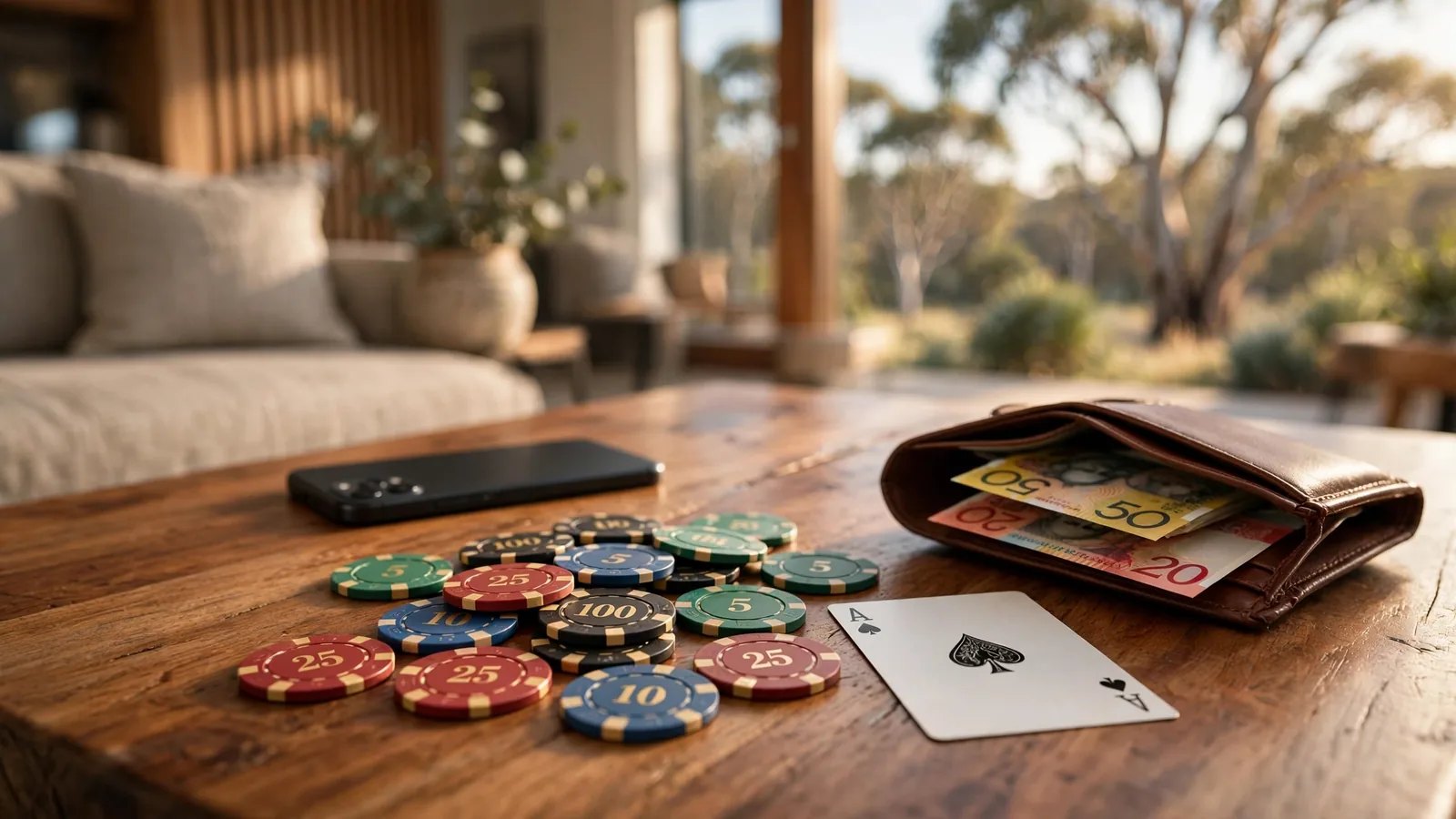
This matters especially for offers described as no-deposit pokies or free spins with no deposit. The phrase can suggest that the promotion carries no meaningful conditions. It does not establish that winnings are uncapped, that every displayed win can be withdrawn, or that a promotion is available on terms that suit the person encountering it. The decisive detail is the cash-out condition itself.
Promotional language tends to put the gift in the foreground and the limit in the margins. That arrangement is familiar well beyond gambling: a benefit is easier to advertise than the boundary around it. In this case, the boundary is monetary. A capped withdrawal can make a large-looking win worth less in cash than its presentation implies. No spin count can answer that question.
Codes add another layer of presentation, not proof. A code associated with a no-deposit bonus does not by itself explain what happens to winnings, whether a cash-out cap applies, or how the offer is otherwise conditioned. The code is a key to a promotion, not a summary of its terms. Its presence says nothing about whether the resulting amount can leave the account.
In Australia, the phrase “Australian pokies” often describes the intended audience or style of an offshore offer, rather than a product supplied by an Australian-licensed online casino. There is no domestic online casino licence for real-money pokies. A promotional label cannot alter that market reality, and it should not be mistaken for a local endorsement or protection.
For any offer encountered, the relevant distinction is between a displayed balance and money that may actually be paid out. The cap is one part of that distinction; the full terms determine what the promotion permits. If those terms do not state the cash-out limit clearly, the promise remains incomplete. A bonus code cannot fill the gap.
- Check the full terms for cash-out limits on free spins.
- Verify if winnings from no-deposit offers are capped.
- Distinguish between a displayed balance and withdrawable money.
- Assume a “no deposit” label means there are no conditions.
- Rely on a bonus code to understand the payout terms.
- Mistake promotional labels for local endorsements.
The attraction is easy to understand. “No deposit” removes the most visible price from the invitation, while free spins turn chance into a neatly packaged gift. Yet the value of a promotion is not measured by the word “free” or by a possible win on screen. It depends on what its conditions allow to be retained and withdrawn. Small print, rather than the generous headline, defines the offer.
Free Play, Random Spins and the Line Between Practice and Money
“Free play” can describe a simulation in which no money is staked, or it can be used loosely for a promotion attached to real-money gambling. Those are different arrangements, despite the shared language of spins and pokies. The distinction matters: a practice session can show how a game looks and how its controls work, but it is not a preview of what would happen with money at stake.
A pokie’s result is generated spin by spin. Each outcome is determined independently by a Random Number Generator, rather than being a step in a sequence that can be read or anticipated. A run of losses does not make a win due; a run of wins does not make another one more likely. Free play does not alter that principle or turn past results into a guide to future ones.
The practice setting can still have a limited use. It may make unfamiliar symbols, buttons or game features easier to recognise before any decision involving money. But familiarity with a screen is not the same as learning a reliable method. The apparent rhythm of play can invite a sense of pattern, while the underlying outcomes remain separate events. The machine offers no memory to consult.

That limit also applies to claims that a free version demonstrates a game’s real-money behaviour. A no-money session can show the version presented in that setting; by itself, it cannot establish how a real-money service is operated, what settings it uses, or what would occur in a later session. A convincing imitation of the interface is still an imitation of the experience, not evidence about every condition beyond it.
The phrase “free pokies” can blur these categories further. A genuinely non-money practice mode is not the same thing as free spins offered within gambling, where the play is connected to an offer and its conditions. The previous distinction is not merely technical: one is practice without a stake, while the other belongs to a real-money arrangement. “Free” is doing a great deal of work.
There is a social reason this language persists. Pokies have long been presented as entertainment built around repetition: press, wait, see. Free play preserves the ritual while removing the immediate monetary stake, which can make it feel harmless or instructive. Yet repetition can teach the hands the sequence without teaching anything about what comes next. That is the boundary: practice may familiarise, but it cannot forecast.
A free-play label therefore says something about the form of that session, not about the certainty, fairness or likely result of another one. Randomness does not become legible through rehearsal. The spin remains its own event.
Randomness
Each pokie result is determined independently by a Random Number Generator; a run of losses does not make a win due, nor does a run of wins increase the likelihood of another.
When a Sign-Up Bonus Becomes a Betting Bill
A welcome bonus can look like extra money while functioning more like a contract for future betting. The important figure is the wagering requirement: a multiplier applied either to the bonus alone or, under some terms, to the deposit and bonus together. Until the required turnover is reached, winnings may not be available to withdraw.
That distinction makes the headline amount a poor measure of value. A specialist review recommends looking for requirements of 35x or lower and describes anything above 40x as punishing. Those are the review’s assessments, not a rule shared by every offer. The terms attached to a promotion determine which amount is multiplied, and the difference can be substantial.
Consider a $500 bonus with a 40x requirement applied to the bonus. The arithmetic produces $20,000 in bets before winnings can be withdrawn. The original offer has not become $20,000 in cash; it has become a turnover target. Bets placed to meet it carry the ordinary possibility of losing, while progress towards the target does not itself guarantee a withdrawable balance.
Now consider a 35x requirement calculated on a $500 deposit plus a $500 bonus. The amount subject to wagering is $1,000, making the required turnover $35,000. The lower multiplier does not necessarily mean the lighter condition: the base used in the calculation matters just as much. A bonus-only multiplier and a deposit-plus-bonus multiplier are not interchangeable descriptions.

The calculation is simple; the consequences are less so. A player may have to keep wagering after a win, and the balance can shrink before the required turnover is complete. If the terms also specify which games or bets count, that can further affect how quickly the target is met. The displayed bonus amount alone cannot settle any of this.
There is a further Australian complication. Real-money online casino games cannot lawfully be offered to people in Australia by operators without a domestic licence, and no domestic online casino licence has been issued. A bonus advertised to Australians does not change that position. It also does not create an Australian-licensed service or make the promotional balance equivalent to cash.
Before treating a sign-up offer as money, its terms need to be read as a calculation: what sum is multiplied, what turnover is demanded, and what must happen before winnings become withdrawable. The small print is the price tag.
Mobile Access Without Assuming an App Exists
A phone changes the scale of a habit. A pokie once belonged to a room with a visible doorway; on a screen, the boundary between a spare moment and a longer session can become less distinct. Whether access is through an app or a mobile browser, the important question is not the shape of the icon but what controls exist around play.
Deposit limits, loss limits and session time limits can place boundaries around money and time. Self-exclusion offers a more decisive stop. These tools address different points in the same pattern: how much is put in, how much is lost, how long a session continues, and whether access should be suspended altogether. Their value depends on being set and respected, not on whether a service fits neatly on a phone.
Mobile Play Controls
- Set a deposit limit
- Establish a loss limit
- Define a session time limit
- Review self-exclusion options
Mobile design can make gambling feel like an ordinary app activity, one more item in a row of icons. That ordinary appearance is not a change in what the activity is. Real-money online casino games remain prohibited services when offered to people in Australia, and no Australian online casino licence exists. A polished screen does not alter that distinction.
BetStop is also not a universal mobile safeguard. It applies to Australian-licensed operators and does not bind offshore sites. Since there are no Australian-licensed online casinos, it cannot be relied on to block access to offshore casino services. That is a narrow but consequential limit: a self-exclusion system has force only where the operator is covered by it.
The language of “top” apps and sites suggests that mobile access is mainly a matter of ranking convenience. But the device is incidental. Controls that limit deposits, losses or session time matter more than whether a service opens in a browser or through an app; self-exclusion matters more still when continued access is the problem. None of these controls turns a prohibited service into a lawful one, or guarantees that an offshore operator will honour a request.

A screen can make a room portable. It cannot make the rules portable with it.
Online Casino Language and the Older World of Gaming Machines
“Pokies” belongs to both the language of online gambling and the older, more visible world of gaming machines in pubs and clubs. The shared word can make the settings seem interchangeable. They are not. A machine on a venue floor sits within a place, among staff, patrons and local rules; an online casino is a service delivered remotely. Measures designed for one setting should not be assumed to govern the other.
The venue has long been where Australian gambling became part of ordinary social geography: near a bar, a meal, a familiar room. Its machines are not merely games in the abstract. They are objects within a business, and their operation can be observed by people on site. That makes venue-level responsibilities legible in a way that online terminology can obscure.

A report by regionriverina.com.au says that, from 1 July, venues with more than 20 gaming machines are required to have a dedicated responsible gambling officer (RGO) on duty whenever those machines are operating. The report also describes a one-month grace period for venues to remove signage and bring in the officers. These are measures concerning physical venues, not a general description of online casino arrangements.
The RGO role places a named responsibility inside the venue. The same report says venues will also have to maintain a gambling incident register. It is intended to record occurrences in which a patron’s behaviour suggests they may be at risk of gambling harm or already affected by it. A register turns an encounter that might otherwise remain a staff member’s private concern into something the venue is expected to document.
There is a social distinction here as well as an administrative one. In a club or pub, gambling takes place in shared space; signs, staff presence and records are part of the institution around the machines. Online, the familiar word “pokies” can evoke that setting while concealing the difference in how the service is encountered. The vocabulary travels more easily than the safeguards.
Venue-Based Safeguards
In physical venues, legislation requires those with more than 20 gaming machines to have a dedicated responsible gambling officer (RGO) on duty and maintain a gambling incident register to document patrons at risk of harm.
None of this makes a venue machine and an online game the same thing. Nor does a venue’s RGO or incident register describe what happens at a remote service. The old room and the new screen carry different responsibilities. Same word. Different world.
Trust, Withdrawals and the Documents That Come Before Them
Trust is often treated as a label attached to a site: trusted, reputable, established. For a player waiting on a withdrawal, the more useful questions are less flattering. How much can be paid out at once? What paperwork must be accepted first? A polished home page cannot answer either.
A specialist casino review reports that some operators set weekly or monthly withdrawal ceilings between $5,000 and $10,000. The same review describes how a $50,000 jackpot might become a multi-year payout plan under such limits. The ceiling matters as much as the headline win: a balance shown on screen is not necessarily money available in one transfer. The exact rule can depend on the operator’s terms, so the withdrawal page deserves attention before any funds are committed.
Verification is another part of the arrangement, not an unusual interruption. Specialist reviews report that casinos commonly ask for identity checks before a first withdrawal. That process can involve a photograph of an identity document and proof of address; some also request a selfie holding the document. Names and addresses that do not match across records can leave a payment waiting while the discrepancy is resolved. In practice, the documents are part of the route to a payout, not an afterthought.
This is where claims about trusted Australian pokies sites can become thin. “Australian” may describe the audience or familiar vocabulary, not a locally licensed service. A reassuring badge does not settle whether a withdrawal cap applies, what documents will be demanded, or how a dispute will be handled. Those are practical exposures, not matters of branding.

There is also a limit to the protection offered by familiar safeguards: BetStop applies to Australian-licensed operators and does not bind offshore sites. That distinction is easy to miss when a service presents itself in local terms. Trust, in this setting, is not a promise of safety. It is a record of what a player may have to disclose, wait for, and potentially lose control over.
The paperwork comes first.
New Games, Different RTP Settings
A new pokie arrives with a title, artwork and familiar mechanics; none of those details, by themselves, establish its return-to-player percentage. The game’s identity can stay the same while its configured return differs between casinos.
A specialist review reports that some providers let casinos choose from multiple RTP settings for a single pokie. That means a percentage attached to a game in one place cannot safely be assumed to describe the same title elsewhere. The distinction is easy to miss: the reels look the same, the name is unchanged, and the underlying game may still be running with a different setting.

RTP is a game-level figure, not a guarantee about the result of an individual session. Nor does a newly released game become more transparent simply by being new. Its launch date and presentation say little about which setting is in use.
This is a narrow point, but a consequential one. Comparing titles alone leaves out the configuration that shapes the published return figure. Where that setting is not clearly stated, the game’s name cannot fill the gap. Familiar packaging is not disclosure.
The Australian market adds a separate boundary: real-money online casino games cannot be lawfully provided to people in Australia by operators without a domestic licence, and no such licences have been issued. That does not make an advertised RTP setting evidence of local authorisation. BetStop applies to Australian-licensed operators; it does not bind offshore sites.
A percentage is only as useful as the setting it describes.
Are online pokies legal for Australian players?
Yes, Australians can legally play on offshore sites that accept them, but companies offering real-money online pokies to Australians without a domestic licence are breaking the law. No Australian-licensed online casinos exist, and players have no legal recourse in Australia if an offshore casino refuses to pay.
What does “wagering requirement” actually mean?
It is the amount you must bet before bonus winnings can be withdrawn, calculated using a turnover multiplier. For example, a $500 bonus with a 40x requirement means $20,000 in bets; if the requirement applies to a $500 deposit plus a $500 bonus at 35x, it means $35,000 in bets.
What is the cost-benefit calculation of casino promotions?
Compare the bonus’s potential value with the betting needed to unlock it and any limits on withdrawals. For example, a $500 bonus at 40x requires $20,000 in bets, while a 35x requirement on a $500 deposit plus a $500 bonus requires $35,000; free-spin winnings may also have a cash-out cap.
Prepared by the Wildtokyoslotshubau.com editorial staff.